
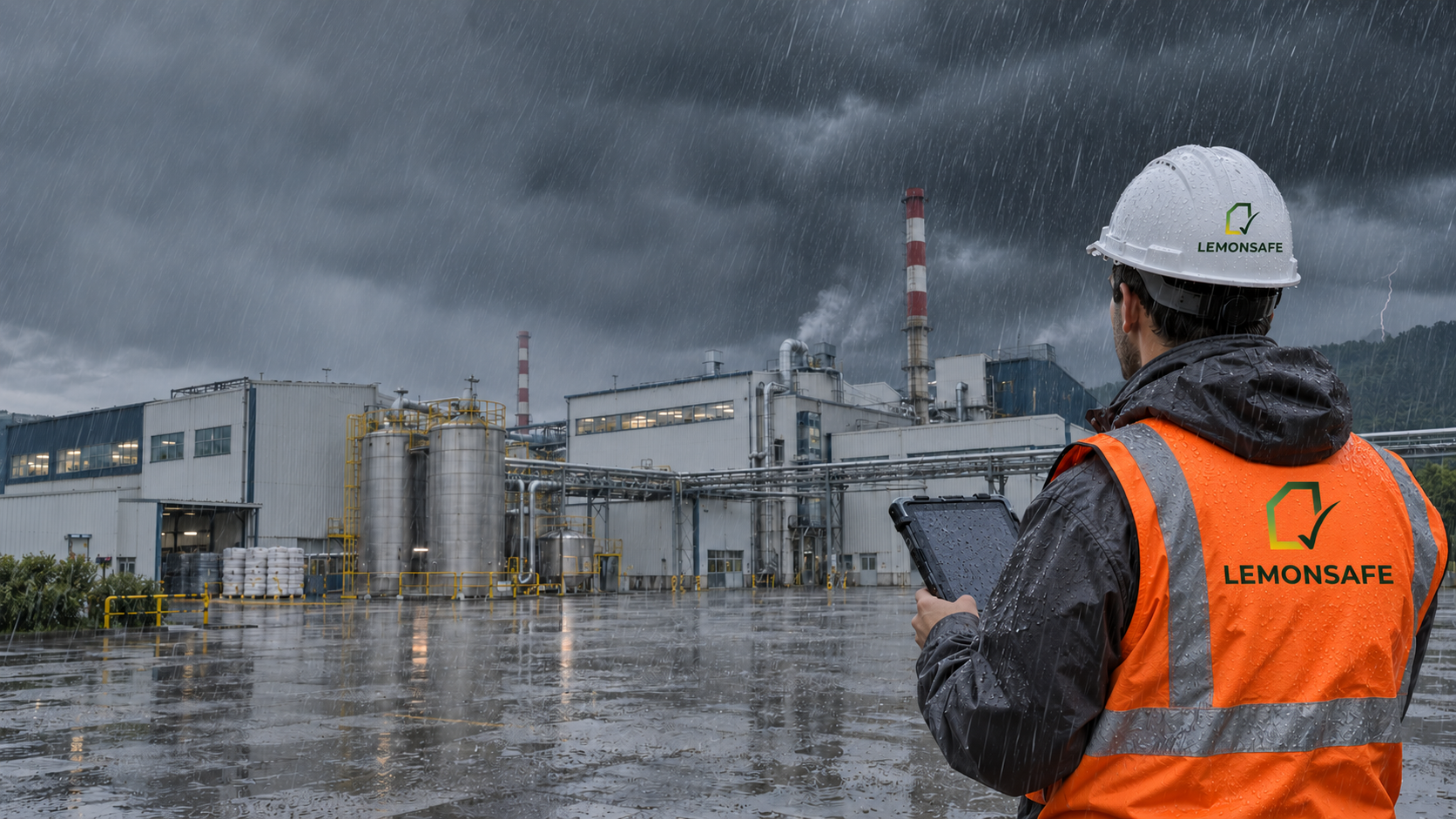
LABORSAFE® Climate Safety Assessment supports organizations in assessing risks and defining procedures to protect workers, facilities, and operations from Adverse Weather Conditions (AWC) and Extreme Weather Events (EWE).
Lemonsafe® launches a new service for Assessment and Preparedness for Adverse Weather Conditions (AWC) and Extreme Weather Events (EME). Called LABORSAFE® Climate Safety Assessment, the service helps organizations answer three essential questions: who decides, what to do, and when to suspend or resume an activity.
Heavy rain, strong winds, thunderstorms, heat, and cold can compromise the safety of people and the operation of facilities. Even relatively frequent conditions can make certain tasks unsafe, depending on worker exposure, the equipment used, and the characteristics of the location.
The new service assesses existing risks and procedures, defines alert and action criteria, and translates this analysis into a technical diagnosis, adjusted procedures, and an action plan.
For organizations with management systems compliant with ISO 9001, ISO 14001, and ISO 45001 standards, it also supports the integration of climate change into these systems.
What is the difference between Adverse Weather Conditions (AWC) and Extreme Weather Phenomena (EWP)?
The distinction lies in the risk that the conditions represent for an activity and the degree of exceptionality of the phenomenon.
Conditions (AWC) are conditions that can create risk, discomfort, or disruption for certain activities, even if they are not rare or exceptional. Heavy rain, wind, significant heat or cold, thunderstorms, and persistent fog may require preventive measures and changes to how work is performed.
For example, wind can compromise a lifting operation, rain can make an access road slippery, and fog can reduce visibility in a traffic area. None of these situations need to reach exceptional weather levels to justify intervention.
Phenomena (EWP) are rare events or events that deviate significantly from the usual behavior for a given location and time of year. Their classification depends on the climatological context and may involve exceptional values of intensity or duration.
Examples include an exceptional heat wave, extreme rainfall, unusually strong winds, or an extreme cold wave. Severe or prolonged drought falls under the broader category of climate extremes.
A weather condition doesn't need to be extreme to make an activity unsafe. Therefore, organizations' preparedness should cover both the most frequent adverse situations and exceptional events.
From weather warnings to decisions on the ground
Following the warnings from the Portuguese Institute of the Sea and the Atmosphere is a fundamental reference for the preparedness of organizations. Applying this information to the reality of each facility requires an analysis of the activities, the people exposed, and the existing vulnerabilities.
A factory with equipment located outdoors, a warehouse with access vulnerable to flooding, and a maintenance team working at heights all present different needs.
It is within this link between meteorological information and operational response that LABORSAFE® Climate Safety Assessment is framed. The objective is to establish action criteria appropriate to each organization, aligned with official guidelines and the conditions actually observed on site.
The assessment helps to clarify who is responsible for monitoring the warnings, how they communicate with the teams, what preventive measures should be applied, and who is responsible for deciding on the suspension and resumption of work.
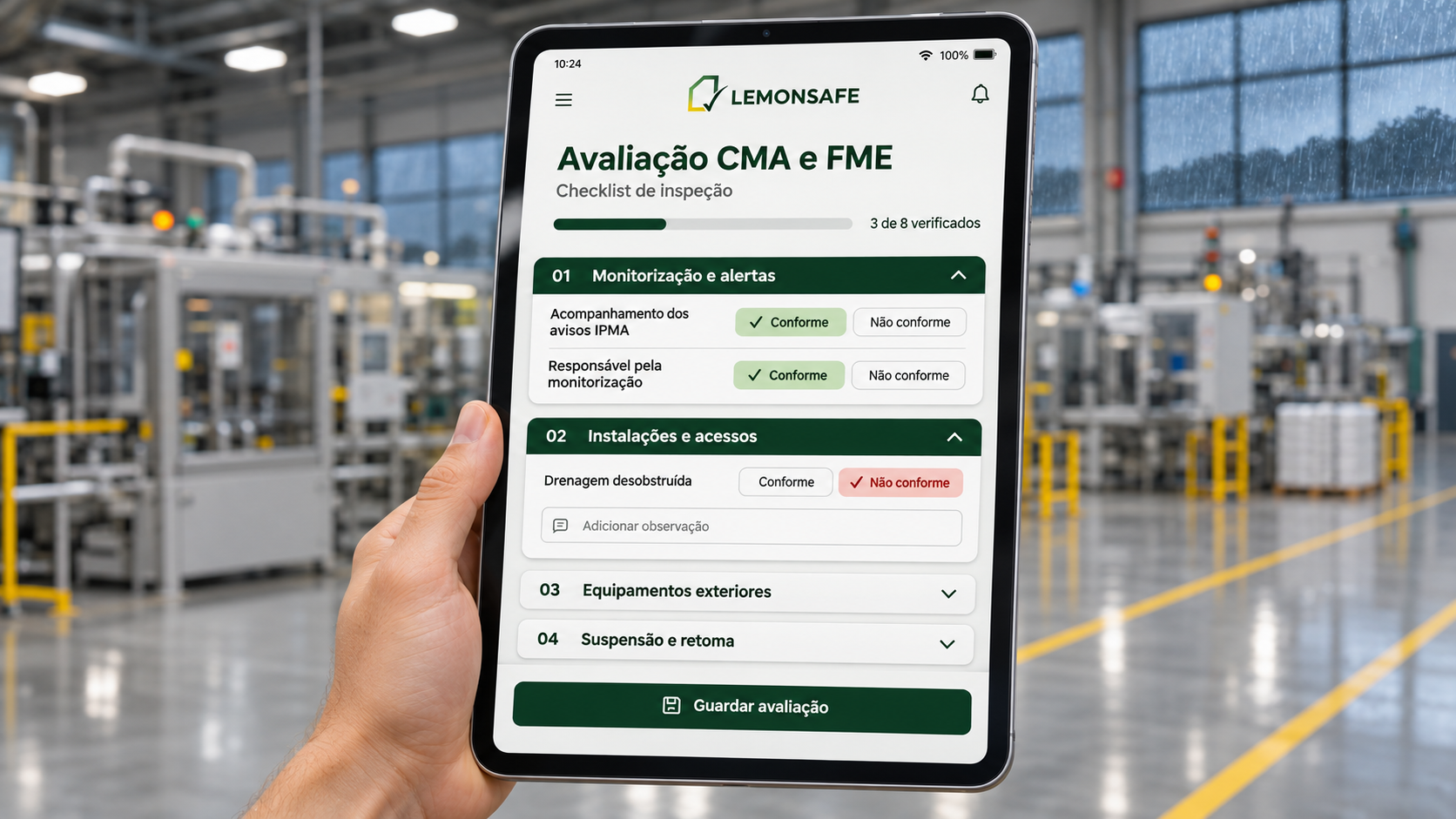
What does the LABORSAFE® Climate Safety Assessment include?
Lemonsafe®'s service is based on risk assessment and review of existing preparedness, with three main outcomes:
Technical diagnosis: identification of vulnerabilities and aspects to improve in preparation for CMA and FME.
Adjusted procedures: definition of alert criteria, action, suspension and resumption of activity.
Action plan: organizing the necessary measures to improve prevention and response capacity.
Depending on the risks identified, preparation may involve adapting tasks during hot periods, exposing equipment and materials to wind, addressing the vulnerability of access routes to heavy rain, or carrying out necessary checks after a flood.
The resumption of operations deserves particular attention. The end of an adverse weather event can leave structures, equipment, or circulation areas affected. Procedures should include appropriate checks before they can be used again.
"The decision must be prepared before the urgency arises."
José Manuel Viegas, founder of Lemonsafe®, explains the need that the new service seeks to address.
What need does this new service seek to address?
"An organization might receive a weather warning and still not know exactly what to do. Who monitors the situation? Who decides to suspend work? How is this decision communicated to the teams? With this service, we want to help transform the available information into clear procedures that are appropriate to the reality of each organization."
What distinguishes a prepared organization?
"It's the kind of company that doesn't need to improvise every decision when the situation worsens. It knows its vulnerabilities, has defined responsibilities, and knows what to check before resuming activity. The decision must be prepared before the emergency arises."
Climate change and management systems
Risk assessment related to weather conditions is also relevant for organizations with quality, environmental, and occupational health and safety management systems.
The changes introduced in 2024 to several management system standards, including ISO 9001, ISO 14001, ISO 45001 and ISO 41001, made explicit the need to determine whether climate change constitutes a relevant issue for the management system. They also added a note on the possibility of relevant stakeholders having requirements related to the topic.
The analysis must address the scope of each system. In terms of quality, it may involve consequences for service delivery and process continuity. In environmental management, it may cover risks related to the environmental aspects of the activity. In occupational health and safety, worker exposure is particularly relevant.
LABORSAFE® Climate Safety Assessment supports this framework by evaluating existing risks and procedures.
Preparation tailored to each organization
The service addresses the needs of sectors such as industry, logistics, construction, maintenance, tourism, and the management of outdoor activity spaces.
The assessment considers the location, the characteristics of the facilities, the tasks performed, and the exposure of people. It is equally relevant for organizations without ISO certification that need to protect their teams and establish an organized response to adverse weather conditions.
With the launch of LABORSAFE® Climate Safety Assessment, Lemonsafe® reinforces its offering of technical assessment and preparation of organizations for CMA and FME.
To learn more about our Assessment and Preparedness for Adverse Weather Conditions and Extreme Weather Events service, contact Lemonsafe® at geral@lemonsafe.pt.
